Royal Mail Storm Eowyn Delivery Delays What Customers Needed to Know
When Storm Éowyn hit the UK and Ireland in January 2025, it caused the kind of disruption that affects far more than travel plans. Roads became unsafe, public transport was cancelled, power cuts spread across parts of the country, and delivery networks had to deal with dangerous wind, blocked routes, and safety warnings.
For many customers, the search term Royal Mail Storm Eowyn came down to one simple question: will my post or parcel still arrive?
The short answer is that severe weather can delay Royal Mail deliveries, collections, and parcel movement, especially in areas under red or amber weather warnings. During Storm Éowyn, the Met Office issued a red warning for wind, meaning danger to life, while a wider amber warning covered the northern half of the UK. The storm brought damaging gusts, with the highest UK gust recorded at 100 mph at Drumalbin, Lanarkshire.
Why Storm Éowyn affected deliveries
Royal Mail depends on people, roads, vehicles, delivery offices, mail centres, air links, and local routes. When severe weather makes those routes unsafe, delivery delays are almost unavoidable.
The issue is not only whether a postie can walk down a street. During a storm like Éowyn, several parts of the delivery chain can be affected at once:
Collections from postboxes, businesses, and Post Office branches can be delayed.
Mail centres may receive items later than expected.
Road transport can be slowed by closures, fallen trees, flooding, debris, or restrictions on high-sided vehicles.
Air transport can be affected if flights are cancelled or delayed.
Local delivery offices may struggle to send staff out safely.
Tracked parcels may stop updating for a period if items are delayed in the network.
Royal Mail’s own service update page explains that its operation uses both an air and road network to move letters and parcels between distribution hubs, mail processing centres, and delivery offices across the UK. That kind of network is strong in normal conditions, but a major storm can affect several points at the same time.
The areas most likely to see disruption
During Storm Éowyn, the worst conditions affected Northern Ireland, Scotland, and parts of northern England, with especially serious warnings for central and southern Scotland. The Guardian reported that more than 4.5 million people in Scotland and Northern Ireland received emergency phone alerts because of rare red weather warnings, with officials warning of dangerous winds and flying debris.
For Royal Mail customers, disruption was most likely in places where it was unsafe for staff to travel or deliver. That included areas affected by red warnings, blocked roads, power cuts, damaged infrastructure, and public safety advice to stay indoors.
Even if a customer lived outside the worst-hit area, their parcel could still be delayed if it passed through a hub, road route, ferry route, airport, or delivery office affected by the storm.
What customers may have noticed
For customers waiting on letters or parcels, Royal Mail Storm Eowyn disruption may have shown up in a few different ways.
A parcel might have remained at the same tracking stage longer than expected.
A Tracked 24 or Tracked 48 item might not have moved overnight.
A delivery scan might have been delayed until the next working day.
A local delivery round might not have gone out if conditions were unsafe.
A collection from a postbox or business could have been missed or delayed.
A next-day item might have arrived later because transport routes were disrupted.
This does not always mean an item was lost. In severe weather, tracking can look quiet because the parcel is waiting inside the network until transport and delivery conditions improve.
Why safety comes before delivery
It can be frustrating when an important parcel is late, but during a storm like Éowyn, safety has to come first.
Red weather warnings are not normal bad-weather notices. They are used when there is a risk to life. The Met Office said Storm Éowyn brought very strong winds, with Northern Ireland and Scotland’s Central Belt experiencing gusts widely above 81 mph, and some places seeing even higher gusts.
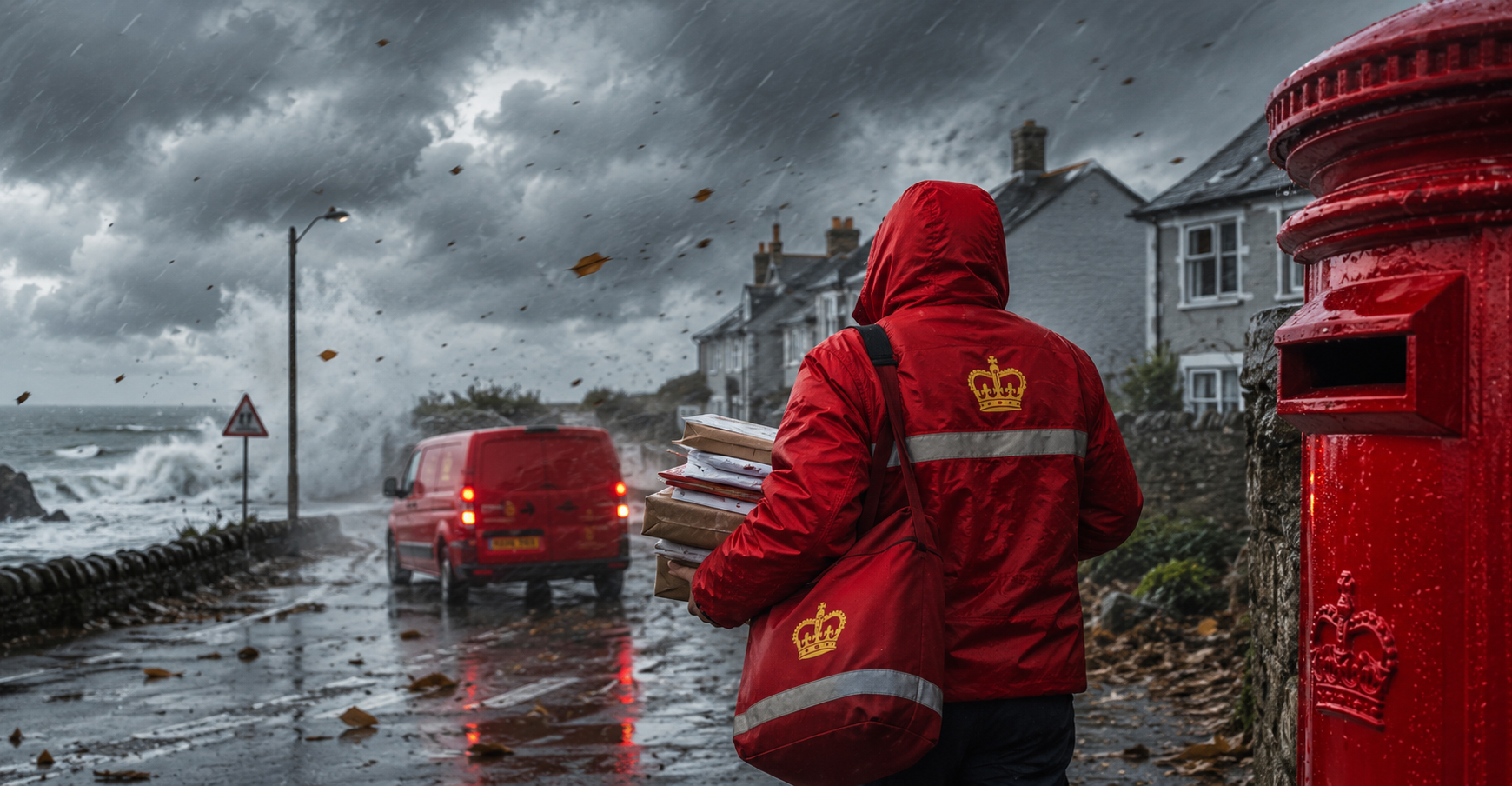
For postal workers, that can mean flying debris, falling branches, unstable roofs, flooded paths, damaged power lines, and dangerous driving conditions. Delivery vans and high-sided vehicles can also be risky in strong crosswinds.
A delayed parcel is inconvenient. A delivery route in dangerous conditions can put workers and the public at risk.
What happened to next-day and tracked services?
During severe weather, premium or tracked services can still be affected. A Royal Mail Tracked parcel, Special Delivery item, business shipment, or online order may move more slowly if the network is disrupted.
Customers often expect tracked items to update at every stage, but weather can interrupt normal scans. A parcel may sit at a mail centre, delivery office, or regional hub until the next safe movement is possible.
If a parcel was due during Storm Éowyn, the best thing customers could do was check the tracking page and then check Royal Mail service updates for wider network information. Royal Mail publishes daily operational updates, including information on delivery and collection services and significant issues in its logistics network.
What businesses and online sellers needed to know
The storm was especially difficult for small businesses and online sellers. If you sell through eBay, Etsy, Amazon, Shopify, or your own website, one day of severe weather can affect dispatch times, customer messages, returns, and delivery expectations.
During a major storm, sellers should be clear with customers. A simple message saying that Storm Éowyn may affect Royal Mail deliveries can reduce confusion and complaints.
Businesses also need to remember that disruption can continue after the storm has passed. Roads may reopen slowly. Backlogs may need clearing. Delivery offices may need extra time to process delayed items.
For urgent orders, sellers should keep proof of postage, tracking numbers, dispatch records, and customer messages in one place.
Why delays can continue after the weather improves
A common customer frustration is this: the storm is over, so why is my parcel still late?
The answer is backlog. If collections, transport, or delivery rounds were disrupted for a day or more, the network has extra mail to process. Delayed items do not vanish once the wind drops. They still need to be sorted, moved, scanned, and delivered.
There may also be local damage. Fallen trees, damaged roads, power cuts, and transport disruption can continue after the red warning ends. Some delivery offices may return to normal faster than others, depending on local conditions.
That is why customers should allow extra time after a major weather event before assuming an item is lost.
What customers should do if a parcel is delayed
If your parcel was delayed during Storm Eowyn, the best approach is simple.
Check the tracking number first.
Look for any scan showing the parcel is still moving.
Check Royal Mail service updates for national or local disruption.
Allow extra time if your area was under a red or amber weather warning.
Contact the sender if the parcel was bought from a retailer.
Keep order numbers, tracking references, and dispatch emails ready.
Avoid opening a lost-item claim too early if the item is still within a weather-disrupted delivery window.
If the parcel does not move for several days after services return to normal, then it may be time to contact the sender or Royal Mail for further help.
What customers should avoid doing
During a storm-related delivery delay, it is easy to keep refreshing tracking or assume the worst. But there are a few things customers should avoid.
Do not assume a parcel is lost just because tracking has not updated overnight.
Do not blame local delivery staff for unsafe weather delays.
Do not travel to a delivery office during dangerous conditions unless it is open and safe to do so.
Do not send urgent items without checking weather warnings and service updates.
Do not promise customers next-day delivery if your area is under severe weather disruption.
Storm delays are usually temporary, but they can affect several parts of the delivery chain at once.
How Royal Mail service alerts help
The most useful place for customers during bad weather is the official Royal Mail service update page. It gives a daily view of delivery and collection services, movement of mail through the network, and any significant logistics issues.
This matters because social media posts can be incomplete or localised. A neighbour may say deliveries stopped in one postcode, while another area may still receive mail. The official service page gives broader operational context.
For individual items, tracking is still important. For wider disruption, service alerts are the better place to start.
Why storms affect logistics so heavily
Storms create problems for delivery networks because parcels and letters do not travel in a straight line from sender to recipient. They pass through collection points, mail centres, distribution hubs, transport routes, and local delivery offices.
A delay in one part of that journey can affect everything after it. If a lorry cannot leave a hub, if a flight is cancelled, if roads are blocked, or if local rounds are unsafe, items can build up quickly.
That is why Storm Éowyn was such a serious event for logistics. It did not only bring rain and wind. It brought conditions that made movement dangerous in some areas.
The wider impact of Storm Éowyn
Storm Éowyn was one of the most severe storms to hit parts of the UK and Ireland in years. The storm caused widespread travel disruption, power cuts, school closures, and public safety warnings. Reuters reported record winds in Ireland and Northern Ireland, widespread power outages, flight cancellations, and serious disruption across transport networks.
In that wider context, Royal Mail delivery delays were part of a much bigger disruption picture. Postal services rely on the same roads, airports, ferries, and safe working conditions as other logistics providers.
What to know before sending parcels during severe weather
If another major storm is forecast, customers and businesses should plan ahead.
Post urgent items earlier if possible.
Check Met Office weather warnings before sending important parcels.
Use tracked services for visibility.
Let customers know if weather may delay dispatch or delivery.
Keep proof of postage.
Avoid relying on tight delivery windows during red or amber warnings.
Check whether local post offices, delivery offices, or collections are affected.
For businesses, it can help to add a temporary website notice during major weather events so customers understand that delays may be outside the seller’s control.
Why the Royal Mail Storm Eowyn story matters
The Royal Mail Storm Eowyn story is really about how severe weather affects everyday services. Most people only think about the postal network when something does not arrive. But behind each letter or parcel are workers, vehicles, sorting systems, local delivery routes, and safety decisions.
During Storm Éowyn, dangerous wind warnings meant some deliveries and collections were always likely to be disrupted. For customers, the key was patience, tracking, and checking official service updates. For postal workers, the priority was staying safe while the storm passed and services returned to normal.
A late parcel can be annoying, especially if it contains something important. But during a storm with a danger-to-life warning, delivery networks have to slow down, pause where needed, and recover safely once conditions improve.