Oil Tanker North Sea: What Happened in the Latest Maritime Incident
Oil tanker North Sea
The phrase oil tanker North Sea drew major attention after a serious maritime collision off the east coast of England. On March 10, 2025, the container ship Solong collided with the anchored oil and chemical tanker Stena Immaculate in the North Sea, close to the entrance to the Humber Estuary. The crash sparked fires on both vessels, triggered a large emergency response, and raised fears about pollution, crew safety, and shipping risks in busy waters.
The tanker was carrying aviation fuel for the U.S. military, not crude oil. That detail matters because many people hear “oil tanker” and imagine crude oil, but in this case the key cargo was jet fuel, which created a serious fire and spill concern after the collision.
The incident later became even more serious after one crew member from the Solong, Mark Angelo Pernia, was confirmed as the fatality. In 2026, Solong’s Russian captain, Vladimir Motin, was found guilty of gross negligence manslaughter and later sentenced to six years in prison.
Where did the collision happen?
The collision happened in the North Sea off the East Yorkshire coast, near the Humber Estuary. The UK Government said the Solong, sailing under the flag of Madeira, struck the anchored Stena Immaculate at 09:47 on Monday, March 10, 2025, around 13 nautical miles off the coast.
The Marine Accident Investigation Branch later described the location as 14 nautical miles north-east of Spurn Head, at the entrance to the Humber Estuary. That area is important because the Humber is a major route for shipping, fuel, ports, industry, and energy traffic.
This was not a remote ocean incident far from land. It happened close enough to the English coast for emergency crews, coastguard teams, tugs, salvors, environmental agencies, and local communities to become involved quickly.
The vessels involved: Stena Immaculate and Solong
The Stena Immaculate was a U.S.-flagged oil and chemical tanker. It was carrying a large cargo of aviation fuel and was at anchor when the crash happened. Reuters reported that the tanker was carrying 220,000 barrels of jet fuel in 16 segregated cargo tanks, though it was initially unclear how much fuel had been released.
The Solong was a container ship sailing under the flag of Madeira. It was travelling towards Rotterdam when it struck the tanker. Reuters reported that maritime data showed Solong was en route to Rotterdam and sailing at cruise speed when the collision occurred.
This combination made the incident dangerous from the start: one vessel carried flammable aviation fuel, while the other carried containers and other cargo. When the two ships collided, both crews were put at immediate risk.
What happened after the impact?
Fire broke out on both vessels almost immediately. The UK Government said initial firefighting attempts were overwhelmed by the size and nature of the fire, forcing both crews to abandon ship. Rescue and firefighting operations were coordinated by HM Coastguard.
A total of 36 people were rescued from the two vessels. Reuters reported that one crew member from the Solong was assumed dead, while the Stena Immaculate crew were brought ashore.
The crash also caused major visual damage. Reuters described aerial footage showing a large hole in the Stena Immaculate’s hull and fire damage along the ship’s length. The Solong was also badly burned and smouldering in the days after the collision.
Why the fire was so serious
The fire risk was high because of the cargo and the location of the impact. Jet fuel is highly flammable, and Reuters reported that at least one of Stena Immaculate’s cargo tanks was hit. Fires and explosions followed, and both ships were damaged badly enough to require salvage work and exclusion zones.
A ship fire at sea is not like a fire on land. Emergency crews cannot simply drive to the scene. They need coastguard coordination, rescue vessels, firefighting tugs, helicopters, specialist equipment, and safe weather conditions. If toxic smoke, fuel leaks, or unstable cargo are involved, the situation becomes even harder.
That is why a North Sea tanker fire quickly becomes a national incident rather than a routine shipping accident.
Rescue operation and crew safety
The rescue response involved coastguard coordination, boats, helicopters, and specialist crews. The UK Government said firefighting and search-and-rescue operations continued through the day of the collision and restarted the following morning.
The Stena Immaculate’s full crew was accounted for and brought ashore. The Solong crew suffered the worst loss, with Filipino crew member Mark Angelo Pernia killed in the crash. AP later reported that Pernia was working on the Solong’s bow and that his body was never recovered.
For readers searching oil tanker North Sea accident, this is one of the most important points: the story was not only about ships, cargo, or pollution. It was also about a fatal failure at sea.
Pollution fears after the collision
The environmental concern was immediate. The Stena Immaculate was carrying aviation fuel, and Reuters reported that fuel was released into the sea after the collision. Conservation groups warned about risks to wildlife, habitats, and food chains. The surrounding area is home to protected seabirds, including puffins and gannets.
Authorities prepared pollution-response equipment, including dispersants and containment booms, in case they were needed. At the same time, early assessments suggested some of the spilled jet fuel may have burned off, though risks remained while both vessels were still damaged.
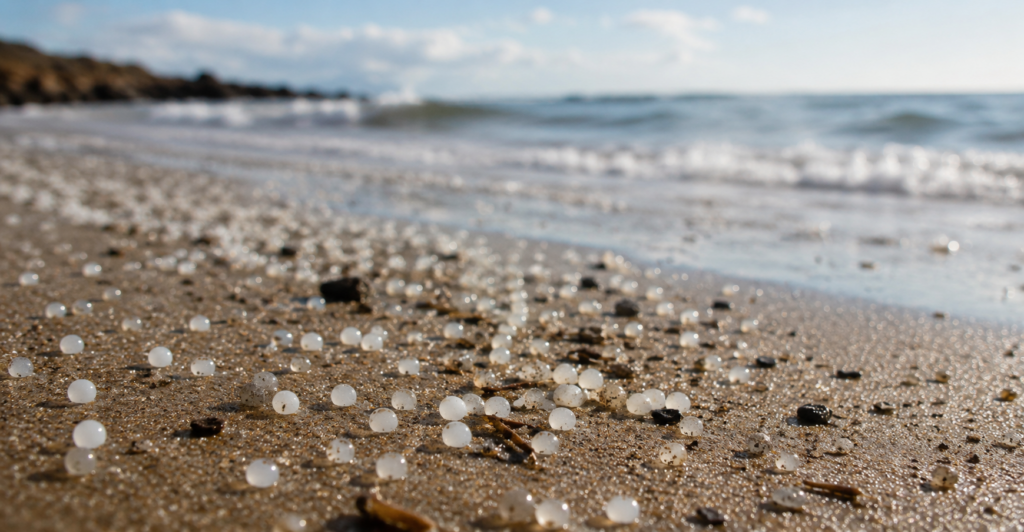
The incident also led to a separate pollution problem involving plastic pellets, known as nurdles, which were later found washing up on parts of the Norfolk coast. The Guardian reported that thousands of plastic resin pellets entered the water after the collision and posed a danger to wildlife.
Why nurdles became part of the story
At first, the main fear was fuel pollution. Later, attention also turned to nurdles, tiny plastic pellets used in manufacturing. These pellets can be eaten by birds, fish, and other marine animals, creating a long-term environmental concern.
The Guardian reported that cleanup work began after nurdles were spotted near the Wash and on nearby beaches. Wildlife groups warned that seabirds could choke, starve, or feed the pellets to chicks, and that plastic could move through the food chain.
This made the North Sea oil tanker incident more complex. It was not only a fuel spill story. It became a wider pollution case involving jet fuel, burned material, plastic pellets, salvage work, and coastal monitoring.
Was sodium cyanide involved?
Early reports raised fears about sodium cyanide, a highly toxic chemical, because of cargo history linked to the Solong. Reuters later reported that the vessel’s owner said Solong was not carrying sodium cyanide, though four containers that had previously been used to store it were being monitored.
This is a good example of why careful reporting matters during maritime emergencies. Early information can change quickly. In fast-moving incidents, one unclear cargo detail can create major public concern, especially when chemicals, fuel, and fire are involved.
For this incident, the confirmed pollution concerns centred more strongly on jet fuel, ship fuel, and plastic pellets, rather than an active sodium cyanide spill.
What investigators looked at
The Marine Accident Investigation Branch published an interim report in April 2025, describing the incident as a fatal collision between the Solong and the Stena Immaculate. It said the investigation involved the collision between a Portuguese-registered container ship and a U.S.-registered oil and chemical tanker, resulting in one fatality.
Investigators typically look at navigation, watchkeeping, visibility, bridge procedures, fatigue, alarms, vessel traffic, radio communications, speed, anchoring arrangements, maintenance, and whether the ships followed safe operating practices.
This incident quickly raised questions because Stena Immaculate was anchored, while Solong was underway. Many readers wondered how a modern cargo ship could hit a stationary tanker in open water. That question sat at the centre of the investigation and later court case.
The legal outcome
The criminal case focused on the Solong’s captain, Vladimir Motin. AP reported that Motin was on sole watch duty when Solong collided with the anchored Stena Immaculate. Prosecutors alleged he failed to summon help, slow down, sound the alarm, or take emergency action in time.
In February 2026, Motin was found guilty of gross negligence manslaughter over the death of Mark Angelo Pernia. The Guardian reported that he was sentenced to six years in prison.
That legal outcome turned the incident from a maritime accident story into a clear case about professional duty at sea. The court’s finding showed that the failure was not treated as a simple navigational mistake, but as criminally serious negligence.
Why anchored tankers can still face danger
Many people assume an anchored tanker is safe because it is not moving. In reality, anchored ships can still be at risk if other vessels fail to detect them, misread their position, lose situational awareness, or fail to keep proper lookout.
A tanker at anchor may be waiting for a berth, waiting for orders, or holding position near a busy port route. Other vessels must still navigate safely around it. Radar, AIS, bridge watches, visual lookout, alarms, and proper route planning all matter.
The Stena Immaculate collision showed how quickly a stationary ship can become the centre of a major emergency if another vessel fails to respond in time.
Why the North Sea is a busy shipping area
The North Sea is one of Europe’s busiest maritime regions. It carries oil tankers, chemical tankers, container ships, ferries, fishing vessels, offshore support vessels, wind farm vessels, cargo ships, and naval traffic. It also sits beside major ports and industrial routes.
The Humber area is especially important because it connects to ports such as Immingham, Grimsby, Hull, and Killingholme. That means large ships regularly move in and out of the region, and some vessels anchor offshore while waiting for access.
With that level of traffic, safe navigation is essential. Even a single failure can put crews, cargo, wildlife, and coastal communities at risk.
What coastal communities needed to know
For people living along the east coast, the main concerns were practical: was there a public health risk, would beaches be polluted, would wildlife be harmed, and would the damaged vessels come closer to shore?
Reuters reported that authorities said the risk to public health was very low, while environmental monitoring continued. Exclusion zones were placed around the vessels, and salvage teams worked to stabilise the situation.
Later, coastal attention shifted towards the nurdles washing up on beaches. This showed why monitoring can continue long after the flames are under control. A ship collision does not end when the fire goes out; pollution, salvage, legal investigation, and insurance claims can last months or years.
Salvage and vessel recovery
After the collision, salvors had to assess the damage, control pollution risks, and work out how to move the vessels safely. Reuters reported that Dutch marine provider Boskalis was appointed to salvage the Stena Immaculate and that specialist ships carrying foam and extinguishing agents were sent to the scene.
Salvage work is highly technical. Teams must consider fire damage, fuel, cargo, hull strength, weather, tides, pollution, safe towing routes, and port access. A damaged tanker or container ship cannot simply be pulled away without careful planning.
The Solong was later towed for assessment, while the Stena Immaculate also required major damage evaluation and repair planning. The cost of such incidents can run into many millions once salvage, legal claims, vessel damage, cargo loss, pollution monitoring, and business disruption are included.
Why this incident mattered beyond one crash
The oil tanker North Sea incident mattered because it touched several major issues at once: crew safety, hazardous cargo, bridge watchkeeping, environmental risk, coastal protection, shipping law, salvage operations, and public confidence in maritime safety.
It also showed that modern ships, even with radar, electronic navigation, AIS, alarms, and bridge equipment, still depend on human attention. Technology helps, but it does not replace proper watchkeeping and decision-making.
For the shipping industry, the Stena Immaculate and Solong collision became a reminder that basic safety disciplines still matter: keep a lookout, respond early, use alarms properly, maintain situational awareness, and do not assume open water is risk-free.
Key timeline of the North Sea tanker incident
March 10, 2025: Solong collided with the anchored Stena Immaculate in the North Sea near the Humber Estuary. Fires broke out on both vessels, and crews abandoned ship.
March 11, 2025: The UK Government updated Parliament, confirming rescue and firefighting operations, exclusion zones, and that the Stena Immaculate crew were accounted for.
March 2025: Environmental monitoring continued, with concerns over fuel, ship damage, and later plastic pellets washing up on parts of the coast.
April 3, 2025: The Marine Accident Investigation Branch published its interim report on the fatal collision.
February 2026: Solong captain Vladimir Motin was found guilty of gross negligence manslaughter and sentenced to six years in prison.
What readers should understand
The clearest version of the story is this: the Stena Immaculate, an oil and chemical tanker carrying aviation fuel, was anchored in the North Sea when the container ship Solong struck it on March 10, 2025. Both ships caught fire, 36 people were rescued, one crew member died, and the incident led to pollution fears, salvage work, an official investigation, and a criminal conviction.
For people searching oil tanker North Sea, the story is not only about a dramatic fire at sea. It is about how fragile maritime safety can become when attention fails, how quickly pollution risks can spread, and how a single collision can affect crews, coastlines, wildlife, shipping companies, courts, and coastal communities.
The North Sea is busy, cold, industrial, and vital to trade and energy. This incident showed why every ship moving through it needs strong navigation, alert bridge teams, working safety systems, and respect for the risks that remain even in familiar waters.