Tesco Pallets Bonfire: What Happened and Why the Retailer Ordered a Probe
Tesco pallets bonfire
The Tesco pallets bonfire story began after claims that wooden pallets linked to a Scottish distribution site may have been used to build the huge Craigyhill bonfire in Larne, County Antrim. The bonfire, part of the wider Eleventh Night tradition in Northern Ireland, was already attracting attention because of its size, safety concerns, and the number of pallets being stacked before it was due to be lit.
Reports said Tesco asked its pallet supplier to investigate whether pallets from a depot at its Livingston distribution centre in Scotland had ended up at the Craigyhill site. Tesco’s position was important: the retailer said it does not own or manage the pallets used in its supply chain, but it had still contacted the supplier and asked for the claims to be checked.
The pallets mentioned in reports were linked to Chep, a major pallet-pooling company known for its blue pallets. Chep pallets are not supposed to be sold or donated to the public. They are hired, reused, collected, repaired, and put back into circulation as part of a supply-chain system.
Why Tesco ordered a probe
Tesco ordered the probe because the claims created a reputational and supply-chain issue. Even though Tesco said it did not own or manage the pallets, the suggestion that pallets connected to a site serving its operations may have been used for a bonfire was serious enough to require checks.
For a retailer like Tesco, pallets are not just scrap wood. They are part of a carefully managed logistics network that helps move goods from warehouses to stores. If those pallets are removed from circulation and burned, it creates questions about asset control, supplier management, unauthorised movement, and environmental impact.
The issue also became sensitive because the Craigyhill bonfire is not a small local fire. Reports described thousands of pallets being stacked at the site, with machinery including a telehandler and crane used in the build-up.
What was claimed about the pallets?
The key claim was that some pallets used at the Craigyhill bonfire may have come from a pallet depot located at Tesco’s Livingston distribution centre in Scotland. The Irish News reported that the depot was believed to be linked to Chep, and that pallets had been delivered to the bonfire site by different vehicles, including a large curtain-sided trailer.
That does not mean Tesco was accused of supplying pallets for the bonfire. In fact, reports said Tesco believed there was no evidence to show pallets at Craigyhill had originated from its distribution centre. Still, the retailer asked its supplier to carry out an investigation because the claim was serious enough to check.
This detail matters because online discussions can easily turn a claim into a fact. The careful version is this: claims were made, Tesco asked for an investigation, and the retailer said the pallets it uses are not owned or managed by Tesco.
Why Chep pallets matter in the story
Chep is central to the story because many of the distinctive blue pallets seen in bonfire-related reports are associated with the company. Chep operates a pallet-pooling model, which means pallets are designed to be shared, reused, repaired, and returned rather than treated as disposable wood.
Chep has said it does not condone the use of its pallets in large bonfires and has appealed to organisers not to use them. The company has also explained that its pallets remain its legal property and are hired rather than sold.
That is why the phrase Tesco pallets bonfire can be slightly misleading if it suggests Tesco owns the pallets. The reported issue is more about pallets moving through a supply chain connected to Tesco operations, rather than Tesco directly owning, donating, or approving their use.
The Craigyhill bonfire background
The Craigyhill bonfire in Larne is one of the best-known Eleventh Night bonfires in Northern Ireland. These bonfires are traditionally linked to the July 12 commemorations of the Battle of the Boyne, when William of Orange defeated King James II in 1690.
The Larne bonfire has drawn attention in recent years because of its huge height. Reports said the previous year’s bonfire reached around 60 metres and could be seen from miles away. Cranes have been used to help build the upper levels of the structure.
Supporters see the bonfires as part of loyalist and unionist tradition. Critics often raise concerns about safety, environmental damage, sectarian tension, and the use of stolen or unauthorised materials. That is why any report involving a major retailer, a pallet supplier, and a huge bonfire quickly becomes a wider public issue.
Safety concerns around large pallet bonfires
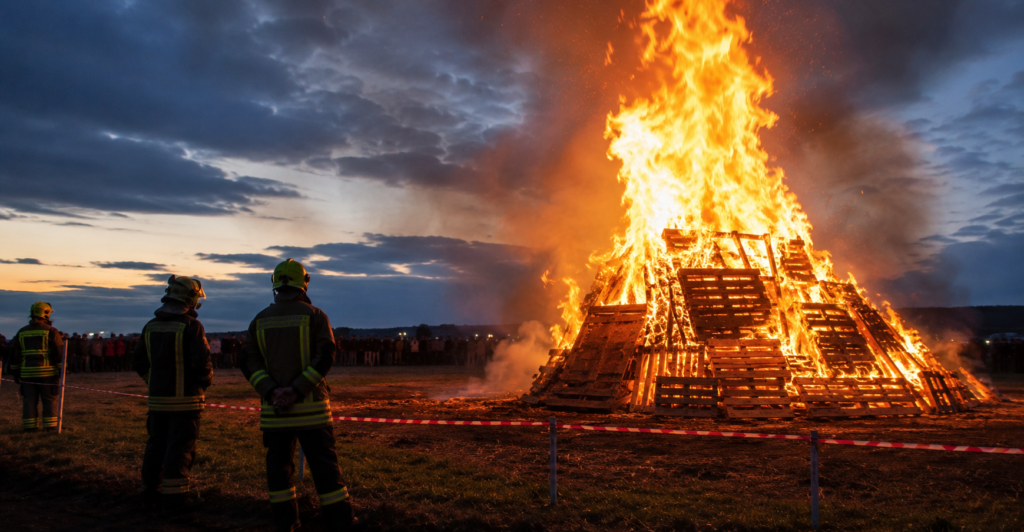
One of the reasons the Tesco pallets story attracted attention is the safety record around very large bonfires. Reports noted that the Craigyhill bonfire had caused controversy in previous years, including after a man involved in constructing it fell to his death in 2022.
Large pallet structures bring obvious risks. The higher they are built, the more dangerous they can become for people stacking materials, operating machinery, or standing nearby when the fire is lit. A structure made from thousands of wooden pallets can also burn intensely and create a large amount of heat, smoke, and flying embers.
That is why the issue is not only about where the pallets came from. It is also about whether huge bonfires are being built in a way that puts workers, spectators, nearby homes, and emergency services under unnecessary pressure.
Environmental concerns over burning pallets
The environmental impact of bonfires is another major part of the story. Burning thousands of pallets releases smoke, carbon emissions, and particles into the air. If pallets contain paint, chemical treatments, dirt, plastics, metal fasteners, or other contaminants, the environmental concern becomes stronger.
Chep has argued that when reusable pallets are burned, the environmental benefits of its circular model are lost. Its system is designed around reuse: pallets are collected, inspected, repaired if needed, and sent back into the supply chain.
In simple terms, burning a reusable pallet destroys something that was designed to move goods many times. It also increases the need for replacement pallets, which can mean more timber use, more transport, and more waste.
Why retailers are pulled into bonfire controversies
Retailers like Tesco can be drawn into stories like this even when they do not directly own the pallets. Supermarket supply chains are huge, with warehouses, suppliers, hauliers, pallet companies, distribution centres, and stores all connected.
A pallet may move between manufacturers, distribution hubs, stores, and collection points. If it leaves the proper system, responsibility can become difficult to trace. That is why Tesco asking its supplier to investigate was a practical step. It allowed the company to check whether there was any link between its distribution network and the pallets seen at the bonfire site.
For big brands, perception matters too. Even if a retailer did nothing wrong, its name being connected with a controversial bonfire can create public pressure to respond.
Are Tesco pallets actually used on bonfires?
Based on the reports, the safest answer is that there were claims about pallets linked to Tesco’s Livingston distribution site, but Tesco said it had no evidence that pallets at Craigyhill came from its distribution centre. The retailer asked its supplier to investigate the matter.
So, it would be inaccurate to say Tesco knowingly supplied pallets for the bonfire. The better wording is: Tesco was drawn into the issue after claims that pallets connected to a supplier depot at one of its Scottish distribution centres may have been used at the Craigyhill bonfire.
That distinction protects the facts and avoids turning an investigation into an accusation.
The role of pallet theft and unauthorised movement
A major question behind the story is how large numbers of pallets end up on bonfire sites in the first place. Chep’s model means its pallets are hired out and remain company property, not public material to be taken, sold, donated, or burned.
The PSNI has said it works with stakeholders and partner agencies on bonfire-related issues, including pallet theft. It also said it takes reports of pallet theft and related criminality seriously because of the wider impact on local businesses and supply chains.
This is why blue pallets on bonfires attract so much attention. If a pallet-pooling company does not sell those pallets to the public, their presence at bonfire sites raises obvious questions about how they got there.
Why the value of pallets matters
Pallets may look ordinary, but they have value. Reports around the Craigyhill bonfire said the material on the site had been estimated by industry insiders to be worth more than £130,000. The Irish News also reported that the previous year’s Craigyhill pyre was believed to include thousands of pallets, including a large number owned by Chep.
That makes the issue more serious than people simply burning waste wood. If reusable pallets are removed from the supply chain, the cost is felt by pallet companies, customers, retailers, manufacturers, and logistics firms.
It also affects availability. A pallet that is burned cannot be reused to move food, household goods, or other essentials. In a busy supply chain, lost equipment can create extra cost and disruption.
Why the story became controversial
The Tesco pallets bonfire story became controversial because it brought together several sensitive subjects: loyalist tradition, retailer responsibility, pallet ownership, alleged unauthorised material, public safety, environmental impact, and Northern Ireland’s annual bonfire debate.
For supporters of Eleventh Night bonfires, the structures are part of community identity and long-standing tradition. For critics, the biggest bonfires raise concerns about pollution, danger, sectarian symbolism, and the use of materials that may not have been legally obtained.
Tesco’s name added another layer. A major supermarket being linked, even indirectly, to a controversial bonfire meant the story moved beyond a local Larne issue and became a broader UK supply-chain and public-relations story.
What Tesco said
Tesco said it had been in contact with its pallet supplier and had requested an investigation. The retailer also made clear that the pallets used in its operations are not owned or managed by Tesco.
That response was measured. Tesco did not claim full responsibility, but it did not ignore the issue either. By asking the supplier to investigate, it showed that the claims were being treated seriously.
For readers, the key wording is: Tesco ordered a probe, but it also said it does not own or manage the pallets. That is the centre of the story.
What Chep said about pallets and bonfires
Chep has said it does not condone the burning of its pallets and has asked bonfire organisers not to use them. It has also said its pallets remain its legal property and are hired rather than sold.
The company has encouraged people to report blue pallets found outside the proper supply chain so they can be collected and returned. Chep says this helps protect reusable assets, reduce waste, and keep pallets in circulation.
That message is important because it frames the issue as more than property loss. Chep presents pallet recovery as part of a circular economy approach, where reusable equipment should stay in use instead of being destroyed.
Why the Livingston link mattered
The mention of Livingston mattered because it connected the Northern Ireland bonfire story to Scotland. Reports said the pallet depot in question was located at a Tesco distribution centre in Livingston, West Lothian.
That made the story more unusual. It was not simply about local pallets being gathered around Larne. It raised questions about whether pallets had moved across regions and whether supply-chain equipment from Scotland had ended up in a Northern Ireland bonfire site.
Again, the important point is that this was a claim being investigated, not a confirmed fact that Tesco pallets from Livingston were used.
Why people searched for Tesco pallets bonfire
People searched for Tesco pallets bonfire because the phrase sounds unusual and raises immediate questions. Did Tesco supply the pallets? Were they stolen? Why were they at a bonfire? Who owns blue pallets? Why did the retailer order a probe? What is Chep’s role?
The story has a strong local-news feel but also a wider business angle. It touches on retail logistics, pallet pooling, supply-chain security, Northern Ireland bonfires, environmental concerns, and public safety.
That mix makes it a highly searchable story because it is not only about one bonfire. It is about how materials from commercial supply chains can end up in public controversies.
What this means for supply chains
The case shows how important asset tracking is in modern logistics. Pallets move constantly between suppliers, warehouses, stores, and return points. When they are not properly returned, they can disappear into the wrong places.
For supermarkets and pallet suppliers, this creates a need for tighter checks, better reporting, secure pallet storage, and clear processes when pallets go missing. It also shows why companies like Chep want the public and businesses to report pallets found outside normal commercial settings.
A reusable pallet only works as part of a circular system if it keeps circulating. Once it is taken out of that system and burned, the whole point of reuse is lost.
What readers should know about the story
The clearest version is this: Tesco was drawn into a bonfire controversy after claims that pallets linked to a supplier depot at its Livingston distribution centre may have been used at the Craigyhill bonfire in Larne. Tesco said it did not own or manage the pallets but asked its supplier to investigate. The pallets were linked in reports to Chep, which says its pallets are hired, not sold, remain its legal property, and should not be used in bonfires.
The story matters because it is not only about a pile of wood. It is about who owns supply-chain materials, how reusable pallets are protected, why huge bonfires raise safety and environmental concerns, and how quickly a major retailer can be pulled into a local controversy when its supply network is mentioned.